From Baddy to Badass: How changes to the Andorians' makeup made them the coolest aliens in Star Trek.
Die Andorianer. Wer sie aus TOS kennt, denkt erst einmal an blau zugespachtelte Schauspieler mit weißen Watterprücken und seltsam künstlichen Antennen. Früher fand ich sie eher mittelgeil … vor allem im Vergleich zu Vulkaniern, Romulanern oder Ferengi. Aber im Laufe der Jahre haben die Veränderungen des Make-ups der Andorianer dafür gesorgt, dass ich mich genauer mit ihnen beschäftigt habe.
Spätestens mit Star Trek: Enterprise wurde die blaue Volllackierung gegen hochwertige Latex-Prothesen ersetzt und als ich sie das erste Mal in Star Trek: Discovery sah, war ich hin und weg. Das waren wirklich coole Aliens, großartiges Make-up und ein cooles und stimmiges Make-up-Gesamtkonzept, das sich in die neue Auffassung der Aliens von Discovery perfekt einreihte.
Since then, an Andorian mask has been sort of the Holy Grail for me and I've already tried various methods to recreate the masks. (I'll be tackling that again soon, by the way, and documenting it here, of course). So this article is about the changes in the makeup of the Andorians in Star Trek and also in general how the special effects have evolved over the last decades.
Today this, tomorrow that: the Andorians over the course of time
Since the Andorians’ makeup has changed so much, they reflect well how special effects makeup has developed over the past decades. That's why I'd like to take a closer look at the Andorians and write down what I've noticed. I'll be publishing several articles over the course of the next few weeks dealing with specific aspects of makeup. In this first post, I'll first go over basic makeup. Or in short, why is blue not just blue?
The Birth of an Alien Species
To understand the changes in the Andorians’ makeup, it's best to first look at how Andorians and their appearance were defined in the first episode in which they made an appearance:
"They are humanoids, tall and quite slim. If at all possible, the ears will be played down (taped back?), but there are two delicately tapered antennae curling from the head. Despite their almost fragile bodies, Andorians are a fierce warrior breed ... Habitually, because of the sensitive antennae, Andorians listen with heads down and slightly tilted. Andorian voices are also different... soft, whispering."
From the script of "Journey to Babel"
So when you read the instruction in the script, you notice three things right away:
- They have no visible ears (more on that soon, when it comes to prosthetics).
- The antennae were in the concept from the very beginning
- There is no mention of blue skin here at all
So why blue? I can't find anything reliable on the Internet. Except a quote from the author of the episode, D. C. Fontana. She concluded the description in the script as follows:
"Andorians are pale blue. Because."
Well, that’s how you score in debate club.
Now, one might speculate that the colour was used because their homeworld, the moon Andoria, is an ice world. Sure, what could be more obvious than making the native species blue. Except maybe to make them white, because that would have given them an evolutionary advantage of camouflage. And after all, humans also turn blue when they freeze. Sounds logical, but it's complete nonsense. At that time, it was not even established that Andoria is an ice world. Or that Andorians come from Andoria at all.
You see, finding a reason for the blue colour is pretty speculative. I would guess that it simply came from the spirit of the sixties to give aliens a strange skin colour (e. g. Orions, or Bele and Lokai from Cheron). And a shining blue corresponded to the colorful world view of that time. Of course, this also saved a lot of complicated prosthetics, because Spock's ears were already almost beyond the budget of the series. The question "Why is the Andorian blue?" is in the same league as "Why is the banana yellow?” For now, the answer probably remains, "Because."
Little Effort, Big Impact
One of the first two Andorians we get to see in Star Trek is Ambassador Shras. His skin tone is pretty simply designed. A light blue base tone with some dark shading. If you compare photos of the actor (Reggie Nalder) with the character you can see that really no prosthetics were used and special effect makeup is also virtually non-existent. Shras is simply Mr. Nalder. Only in blue.

“The makeup chosen to color Andorians was Max Factor Aqua Blue cream stick, highlighted with a slightly deeper blue cream liner to shadow the face.”
„Star Trek: Aliens & Artefacts“, p. 49
So you could feel pretty sorry for the guy, because this reads like he was hidden under a very, very thick layer of cream.
A purple tone was chosen for the shading, darkening the eye sockets and emphasizing the cheekbones and tip of the nose. A larger area on the cheeks made them look a bit more sunken and overall this emphasized the slender, fragile appearance of the Andorians. The neckline of Nalder's costume was quite low and therefore revealed his neck and the base of his neck. Purple accents were also used here.

One Concept For All
The makeup of his attaché Thelev (William O'Connell) was designed in an analogous way. I'm not entirely sure, but it seems that both actors' lips were also coloured with the darker purple. If that was the case, however, the colour probably didn't last that long, as in many of the pictures I've seen of the two of them, the shade of the lips is hardly distinguishable from the base tone of the skin. All in all, I think it's fair to say that although the darker accents were purposefully placed, the makeup as a whole looked extremely flat and painted-on.

In "Whom Gods Destroy" we see another Andorian in the psychiatric facility on Elba II. Here there were hardly any changes in the make-up of the Andorians. Here the makeup department stayed true to itself. White (rather uninspiredly cut) wig, antennae, all there. Nothing changed in the skin tone and makeup either. We still have a light blue base tone with purple accents, although it seems to me that the dark eye sockets are a bit better blended here and their edges are not quite as strict as they were on Shras and Thelev. Still, they are rather coarse.
All Just For Television!
Keeping in mind the quality of the TV sets of the time, it must be said that the makeup certainly looked very convincing. Even if it might seems retro on 4K TV today, of course, it was well applied and executed and seemed very exotic at the time. It's also important to remember that many makeup artists learned their craft for or at the theater back then. There, the distance from actors to audience makes it necessary to overemphasize makeup. But in a nutshell, as far as the Andorians in TOS are concerned, you can say: blue skin, white hair, antennae - it all screamed "Alien."
The Movie Era: Better Effects, Better Make-up, Better Cameras
With Star Trek I: The Motion Picture, completely new possibilities came up, both budget and special FX makeup-wise. So it's no surprise that for the first feature film, the aliens were redesigned, and so there were also big changes in the makeup of the Andorians. Their forehead got latex prosthetics and the face colour was also more sophisticated. It seems that the skin tone was chosen a bit more towards green (very slightly). I can't say for sure, since I basically only found a picture of a lady doing a makeup test. In any case, the makeup was shaded much more complex, especially also to highlight the prosthetics. Overall, the look no longer looks so flat, but rather has depth.

![]() One Step Forward and Two Back?
One Step Forward and Two Back?
But the change in makeup did not always advance. The producers deviated from the prosthetics again in Star Trek IV: The Voyage Home and Star Trek V: The Final Frontier. In the former we see two Andorian Starfleet officers and in the latter the projection of a supposed Andorian god. The skin tone in all three is definitely darker, almost going cobalt blue in the case of the Andorian god. The far more advanced colour scheme here probably goes hand in hand with the evolution of the colours. I would guess that water-soluble makeup was used here, which allows for much better coverage without plastering a face over.
Instead of the highly contrasted shades from TOS, these Andorians had more more subtle shades, probably also with multiple layers to give the makeup more depth and vibrancy. Especially with the older Commodore with the high forehead, you can see the actual skin and pore structure of the actor much better.
The Golden Age: Andorians in Star Trek: Enterprise
For a long time, we didn’t see much of the Andorians (I leave the short appearances in TNG aside). But they came back with full force, the make-up of the Andorians was changed fundamentally. As they played a major role on Star Trek: Enterprise. Accordingly, they were completely redesigned once again. The producers of the series, Rick Berman and Brannon Braga, really wanted to bring the Andorians to the start. But more modern and better.

His [Braga's] confidence that the creative team could give the Andorians a ‘cool’" appearance was due to makeup technology having greatly advanced.
Star Trek: The Official Starships Collection, issue 37, p. 10-11
And indeed, it was. In addition to an intricate prosthetics forehead in classic Star Trek fashion, the Andorians were even given movable, remotely controlled antennae.
In my opinion, the more sophisticated make-up only made it possible for the former side characters to now become plot-bearing roles. Even at first glance, you can see on them that the makeup was applied quite differently.
We applied the blue in subtle layers to give the skin a translucence instead of just slathering on blue paint.
Brannon Braga in "Star Trek: Communicator," issue 136, p. 37
The base was a much lighter, more delicate blue applied on a foundation of skin tones. It was also given numerous darker shades, even infused with pink tones. I suspect the pink was also used to distract from areas of the original skin that were translucent, such as the eyelids or lips.
In Jeffrey Combs' photos, it's also easy to see that the individual layers were applied as patches and splashes of colour, a technique widely used to give opaque latex prosthetics the appearance of translucent skin with multiple layers . And, of course, it also distracts from the edges of the prosthetics.
Simply Peaking: Andorians on Discovery
The changes to the Andorians' makeup knocked me right off my feet. One reason definitely was the nature of the makeup. They look alien, mysterious, and deserving of the term aliens - without deviating too much from the usual Star Trek look.
The new Andorians have a variety of silicone prosthetics on their faces, which gives them a sophisticated and truly alien look without the actors having to wear a full face mask.

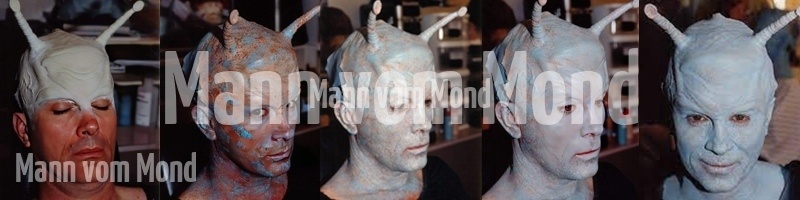
Unlike latex prosthetics, silicone ones are translucent, which basically gives them an appearance that is much more reminiscent of skin. This can be seen particularly well in the tips of the antennae and the outgrowths in the eyebrow area. Latex is completely opaque compared to this. In the video „Becoming a Star Trek: Discovery Andorian“ you can see very nicely how the overall artwork is applied - and what an effort it probably is for everyone involved to get through it. You can also see in this video that the prosthetics themselves already have a base colour of different shades of blue with darker accents that highlight tendons, dimples and wrinkles to provide a basic depth.
On top of that, several layers of light and dark shades are applied by hand and airbrush to achieve the final effect. Especially if you compare the second picture from the left and the final result, you can see how vivid, deep and real the skin looks and how much the individual elements of the prosthetics are highlighted by the colours. What is interesting here is that the colors all come from the same blue spectrum. There is no contrast here with violet or pink, but with different lighter and darker versions of the same shade of blue. All always very clever, never obtrusive or overdone.
It Ain’t Easy Being Blue
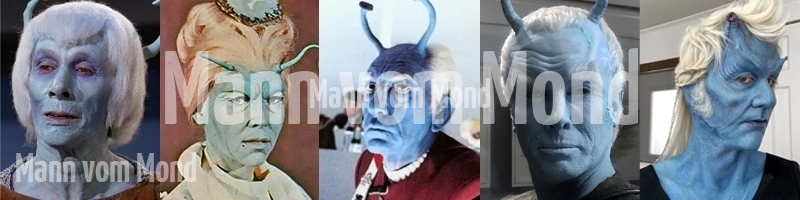
I think in this article you can see very nicely the changes in the makeup of the Andorians and how the makeup artists on Star Trek tried to create an outstanding look in the Andorians with simple means. For the sixties, these aliens were already very sophisticated. But as time went on, the options available to the artists became more sophisticated. And they had to become so, as television technology got better and better (and probably budgets, too). The changing skin tone of the Andorians alone shows what has happened in the last six decades and how much more realistic the make-up of the blue bloods has become. New techniques, new materials and new ideas revolutionized the craft - and continue to do so today.
What is striking, however, is that no matter how complicated the makeup was, the actors always had to spend a long time in makeup. Just getting the skin tone right is complicated, especially the more convincing it is supposed to look.
Coming Up: Andorian Antennae
In my next blog post, I want to look at the antennae and the other changes in the Andorian makeup. Again, these have not only changed for technical reasons, but also reflect aesthetic principles that the makeup departments wanted to fulfill. So stay tuned, it remains exciting.
Would you like to learn more or would you like me to take a closer look at a makeup? Then just write me your ideas and suggestions in the comments or privately via my Contact Form.
Leave a Reply