The Andorians 2: Antennae, Anteannae, So Many Antennae.
In the article I wrote a couple of days ago, I took a closer look at the Andorians’ skin colour, noting how makeup effects have improved over time. From a simple, two-tone makeup in TOS to modern silicone masks in DIS, a lot has changed. In this second instalment, I'd like to address another aspect of the special FX makeup that makes these aliens so unique: the Andorian antennae.
First, an Announcement.
For all the fans of the Andorians, I will soon make a tutorial on how to relatively easily and cheaply make your own Andorian antennae. And for those who prefer ready-made stuff, there are a few resources from the internet at the end of the article.
What So Andorian Antennae Do Anyway?

For many makeup artists today, it's important that masks and prosthetics come across as believable. Individual elements should therefore always appear as if they serve a specific anatomical purpose. In the case of the Andorians, it's not like that – what their antennae actually do has yet to be officially confirmed in canon.
The script for the animated episode "Yesteryears" says about the Andorians' antennae: "(The antennae) are their listening organs; therefore, no ears are in evidence. When an Andorian listens to anyone speak, he bows his head slightly to get maximum 'receiving'. " So are the antennae the Andorian version of ears? No, they can't be. Because later in the movies, and of course in ENT, we see that Andorians actually have a healthy set of ears. And why would they have ears and antennae at the same time if both serve the same purpose?
In the book "Worlds of the Federation", which is not canon though, it says: "The Andorian retina consists exclusively of intensity-sensitive rods and is not able to recognize colors. However, Andorian vision is supplemented by the dual antennae, which contain a complex matrix of light-sensitive cones in addition to auditory receptors" (Worlds of the Federation, p. 22, 1989). So what now? Ears and eyes?
Or a Completely Different Function?
The first draft of the script for "The Andorian Incident" (Star Trek: Enterprise) notes that the Andorians evolved from "subterranean creatures." Therefore, their antennae could sense smells and vibrations, which would help the Andorians find their way in low light conditions. So the olfactory and tactile senses come in as well.
In Star Trek: Enterprise, we also see that the antennae can move, complementing the emotional body language. So let's keep it short and sum up: We don't know exactly what Andorian antennae are for anyway. But maybe we shouldn't be so precise about it, because no matter what their deeper meaning may be: They always look cool!
Now let's assume that function follows form and take a closer look at the Andorian antennae design.
Inspired By Insects? The Antennae of the TOS Andorians
In the TOS episode "Journey to Babel", we meet an Andorian ambassador and his attaché. They are the first representatives of their species that we ever see on Star Trek, so it can be forgiven that their design might not have been completely thought out yet.
Shras, the ambassador, already shows us the most important features of his species: white hair, blue skin and two antennae growing out of the back of his head. This position sets the TOS Andorians apart from all other incarnations. All later appearances show Andorians with antennae much further forward.

The shape is also unique. They are made up of individual segments that are at angles to each other. This gives them a very insectoid look, at least to me. Their posture also underscores this appearance. They are curved and directed towards each other, almost like the mandibles of a spider or ant.
Of course, these antennae couldn't move yet. That was not possible with the budget of a weekly series and the technology of the time. And in general, the special FX makeup was rather low-budget. But no less imaginative.
Smart Ideas for a Show With Limited Budget
„(Fred) Phillips (der Make-up-Designer) modellierte die Antennen mit Knetmasse, und laut Star Trek Archivar Richard Arnold benutzte Phillips die Enden von Fadenspulen für die Spitzen der Antennen. Die Stiele wurden aus einem starren Material hergestellt und an den weißen Perücken befestigt“ (Star Trek: Aliens & Artifacts, S. 49). Eigentlich ziemlich clever. Günstig, praktikabel, kreativ und leicht zu reproduzieren, wenn man mal wieder Andorianer auftreten lassen möchte.
Just as smart was the idea of attaching the antennae to the back of the head. This made it easy to hide the attachments for the camera and have them in a place that was exposed to much less movement. So it didn't matter so much if the antennae were particularly light. From my own experience, I know that the more forward the Andorian antennae attach, the more annoying and irritating they are. With every nod, no matter how small, you have the feeling of a foreign body on your head.
The Movie Era; or: Where Do the Andorian Antennae Actually Belong?
Several years passed between TOS and the first feature film. A time in which the art of special effects makeup made massive progress and opened up all kinds of new possibilities for makeup artists. And of course, the budget of a feature film is not comparable to that of a weekly television series. In a makeup test photo for Star Trek: The Motion Picture, an Andorian woman can be seen. The first thing you notice about her: the antennae had wandered!

They also look more organic, tapering to the ends, which now no longer looked like satellite dishes, but rather tapered off into small curves. In addition, they come out of a kind of skin fold and protrude outward.
The Later Movies
In Star Trek IV: The Voyage Home, two Andorians appear at Starfleet headquarters. Their antennae are in roughly the same place as the Andorian woman’s, but are far longer and have tips that resemble suction cups. All in all, they also show the same diameter along their entire length and no tapering. The skin pocket is absent, instead they come directly out of the forehead.
The Andorian god in Star Trek V: The Final Frontier, on the other hand, has his antennae quite far back on his head. They are smaller, about the size of a finger, and more reminiscent of the Andorian antennae from Star Trek IV. But since he also doesn't have the same neatly arranged hairstyle of his predecessor, this is probably a good place to put the antennae in or on the wig.

The Next Generation of Andorian Antennae
According to my research, two Andorians appear in Star Trek: The Next Generation. One of them is Data's "daughter" Lal, who is considering an Andorian look as a possible appearance for herself. I will leave this one out of my analysis, as it does not represent a typical Andorian for many reasons. The concept of this Andorian design is so fundamentally different from the classic Andorians that it could just as well be a completely different species.
In the episode "Captain’s Holiday", a similar Andorian can be seen briefly in the background. What strikes me as worth mentioning about him, however, is a quote from the text commentary for the episode "The Andorian Incident" from the first season of Star Trek: Enterprise that refers to him: "The look of the Andorian Risa tourist was designed by Michael Westmore who used electronics from a novelty potted plant toy which was built to respond to sounds so the plant danced to music, voices or noise.”

So here we have some experimentation with moving Andorian antennae even before Star Trek: Enterprise. But unfortunately, "the idea to make the antennae twist in response to sounds did not work on camera” Too bad we didn't get to see that. Andorian antennae dancing to the intro music of TNG might surely have looked interesting…
The Renaissance of Andorian Antennae in Star Trek: Enterprise
After a long dry spell in Star Trek: Deep Space Nine and Star Trek: Voyager, in which we don't get to see any Andorians, the blue aliens virtually experience a rebirth in Star Trek: Enterprise. Here, the somewhat stale side characters become real main characters – which is not least due to the excellent performance of Jeffrey Combs as Commander Shran.
The Andorian antennae here have once again migrated to a point quite high up on the forehead and have been integrated into the actors' forehead prosthetics. Also, the makeup department apparently went back to its origins here and gave the antennae a segmented look and a gaping opening at the end.
The length of the antennae now differs between male and female Andorians, with the females' being slightly shorter. It's interesting to note that on the antennae, the makeup concept has been changed. Because although we see in episode 13 of the fourth season ("United") at the latest that Andorian blood is blue, the insides of the antennae tips are pink. Thus, they go along with the colour concept of the TOS Andorians, which I already discussed in the last article: Under the blue colour, various pink and skin tones were applied, which can also be found here on the antennae. 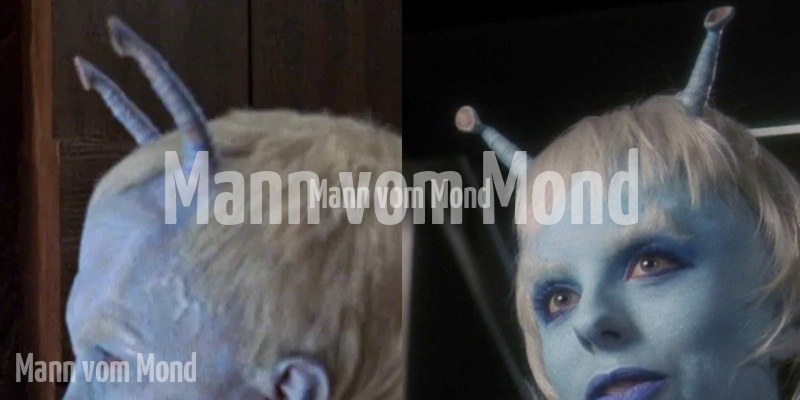
The Live of the Antennae: the Andorians' Antennae Start Moving
Probably the most remarkable feature of the new Andorians is the mobility of their antennae, an idea of Star Trek veteran and makeup supervisor Michael Westmore. After much hesitation due to doubts about the feasibility and practicality of this idea, it was implemented anyway. The concept is convincing: the antennae are now also used as a tool for emotional subtext. Shran actor Combs recalls, “when anger came up, they were like a cat's ears, they would just flare back. And when you were curious about something they would come forward [....] We were trying to find another position for the antennae to show gratitude. We came up with a little heart-shaped position where the tops come in and touch each other”.
The new Andorian antennae presented a daunting challenge to the makeup department and production. First, a mechanism had to be integrated into the prosthetics that moved them – driven by small servo motors. The wiring, mechanics and a power source had to be hidden, and each actor needed a puppeteer to control the antennae. Also, I suspect, a fixed base for the antennae must be integrated so that their movement has a counterpoint. Otherwise, it just doesn't work.
Newly Discovered: the Andorian Antennae in Star Trek: Discovery
Star Trek: Discovery presented us a whole new concept of the Andorians – and of almost all other aliens. By switching from foam latex prosthetics to silicone masks, a whole new set of makeup effects could be created. Most aliens now have a more polished appearance. And that's what happened to the Andorians, too.
Man kann sagen, dass die Fühler der Andorianer nun ein Zusammenspiel aller früheren Varianten sind. Zuerst einmal sind sie weiterhin an der Vorderseite des Kopfes befestigt, ungefähr auf der gleichen Höhe an der oberen Stirn wie bei den Enterprise-Andorianern. Und auch, wenn sie fleischiger und dicker sind als die Version aus Star Trek: Der Film, ähneln sie diesen doch sehr. Auch die Fühler der Discovery-Andorianer beginnen bauchig an der Stirn und verjüngen sich zu den Enden hin. Die Enden wiederum ähneln wieder denen der Enterprise-Andorianer, sie laufen in angespitzte Ovale aus , die auch rosa beziehungsweise fleischfarben durchschimmern. Ein Bekannter von mir nannte sie einmal „Schneckenfühler“ und ich glaube, diese Beschreibung kommt dem Ganzen ziemlich nah. Und auch, wenn man es nicht immer sehen kann: Die Discovery-Andorianer haben ebenfalls bewegliche Fühler.

What's New with Discovery Andorians?
Außerdem fällt auf, dass die Prosthetik über den Augen ebenfalls in kleinen Knubbeln ausläuft, was die Vermutung nahelegt, dass es sich hier um ein weiteres Paar kleinerer „Sekundärfühler“ handelt.

In general, the antenner are better integrated into the overall concept of the silicone mask. The various bulges on the forehead could suggest the course of muscle cords or tendons of the antennae, because the antennae themselves – although they are smooth in contrast to the antennae in TOS and Enterprise – seem more muscular and organic than all their predecessors and are perhaps comparable to a human tongue, which is also a muscle.
Perhaps one last tidbit about the Discovery Andorians: so far, I haven't noticed any Andorian in the series whose ears weren't covered by a white wig – possibly a homage to TOS and the idea that Andorian antennae replace ears.
Andorian Antennae: a Summary
Along with the Tellarites, the Andorians are probably among the aliens that have changed the most over the last sixty years. In my opinion, this is due to two things: a change in design standards and the evolution of special FX makeup techniques. On top of that, it's never been defined exactly why the Andorians are blue and have antennae. Therefore, the motto: “what's not wrong is right” probably applies to the Andorians.
While many of the peculiarities of the Andorians have remained the same or at least similar over time, their antennae have probably undergone the greatest changes. From insectoid to slug-like, from rigid to mobile, from large to small, from organic to skeletal. Actually, there's hardly a variation that Star Trek's makeup artists haven't tried.
Personally, I like Discovery’s Andorians' antennae best. To me, they look the most real and natural, if you can even say that about a fictional alien species. I also find the way they are integrated into the makeup compelling, because while in previous incarnations they almost seem like a feature added later, in Discovery they are fully integrated. Their look is just the most coherent for me.
But I also know that opinions are divided here. But as is so often the case with Star Trek: everything goes. If you don't like a certain mask, you just have to overlook it and take the Andorians for what they really are: Another attempt to tell exciting stories about the human future. And, of course, as a testament to the incredible progress that special FX makeup art has made.
What do you think about the Andorian antennae? Am I right in my guesses or do you see something different? Let me know in the comments.
Do You Want Your Own Andorian Antennae?
If you want to become an Andorian yourself, I have a few more tips for you here:
- I will soon publish two tutorials n how to make your own Andorian antennae on kleinem Budget oder auch etwas professioneller small budget or a bit more professionally.
- On Thingiverse you can find free 3-D printable files for antennae in different variations.
- On Etsy you can find a store with Enterprise-inspired foam latex prosthetics for Andorians.
- Also on Etsy you can buy moving Andorian antennae for sale
Leave a Reply